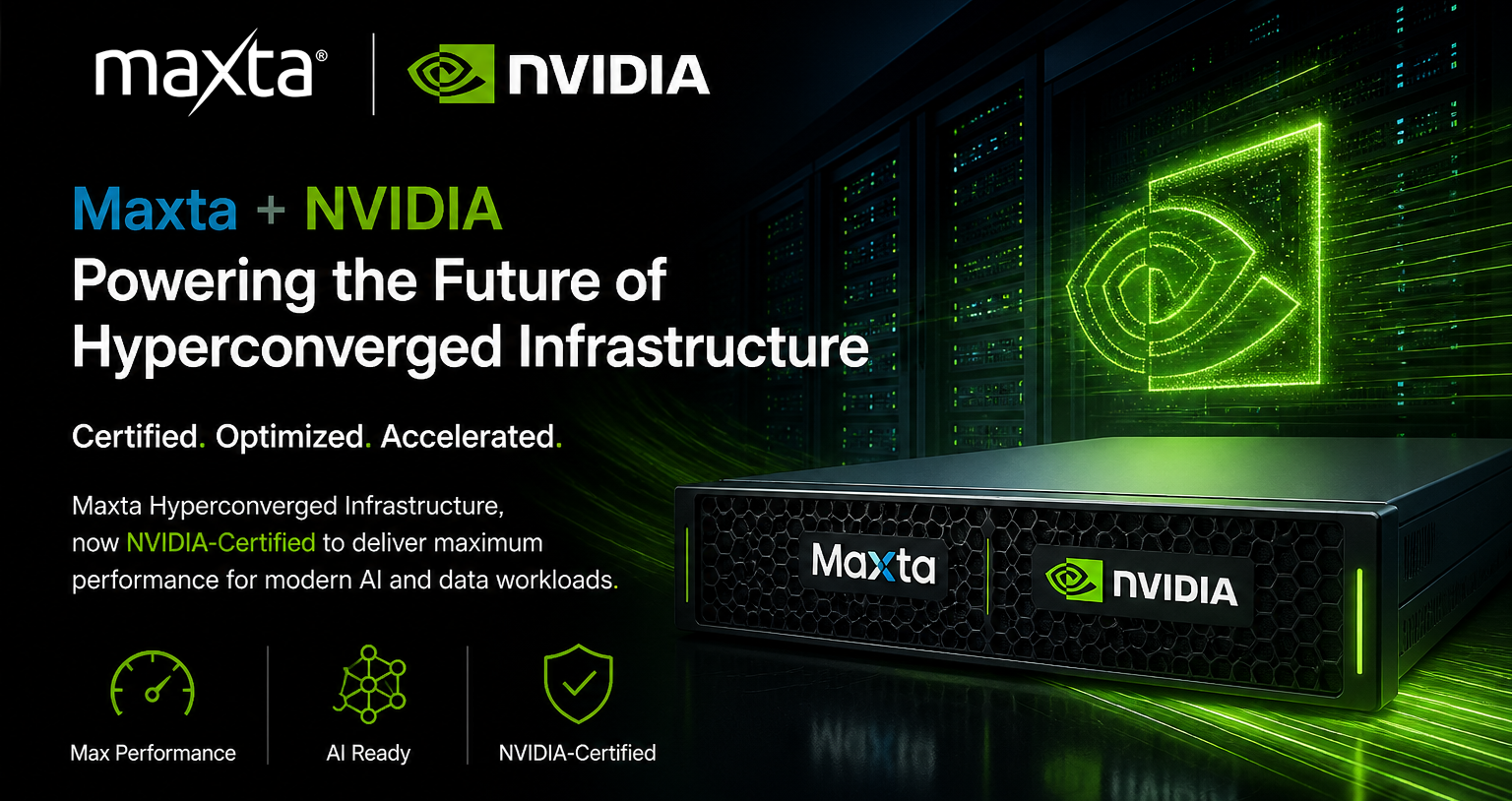
NVIDIA has highlighted Maxta MaxDeploy on its global Hyperconverged Infrastructure (HCI) reference page as a featured partner alongside NVIDIA Cumulus Linux, validating Maxta's role in enabling a new generation of software-defined, AI-ready data center infrastructure. For enterprises trying to make sense of how to build private, scalable, and economically viable AI platforms on-premises, this pairing answers a question that has quietly become the defining challenge of 2026: how do you deliver AI like you deliver hardware?
What NVIDIA's HCI page says — and why it matters
NVIDIA's Hyperconverged Infrastructure page positions HCI as the antidote to traditional three-tier silos of compute, storage, and networking. Distributed storage software replaces dedicated SAN arrays. Open network operating systems replace vendor-locked switching. The result is an architecture that scales out, automates provisioning, and consolidates rack space — what NVIDIA calls a "Data Center in a Rack."
Inside that vision, Maxta is named explicitly. The page features a quote from Yoram Novick, Founder and CEO of Maxta, on combining Maxta's hypervisor-, server-, and storage-agnostic HCI software with NVIDIA Cumulus Linux to streamline deployment for enterprise customers. Two things matter here. First, the partnership is not a logo exchange — it is a working solution path that NVIDIA itself documents. Second, the framing is exactly the framing modern AI buyers want: open, agnostic, and turnkey.
HCI was born to kill the SAN. Now it is reborn to deliver AI.
The original HCI movement, in which Maxta was a recognized pioneer, fundamentally changed enterprise storage. By collapsing compute and storage into a single distributed software layer running on commodity x86 servers, HCI removed the cost, complexity, and rigidity of monolithic storage arrays. Gartner named Maxta a Visionary in its Magic Quadrant for Hyperconverged Infrastructure; the company holds patents on shared data storage in HCI environments; and Maxta's MxIQ analytics pioneered the predictive operations model that enterprise IT now takes for granted.
The AI era is forcing a similar reckoning, only this time the silos to be dismantled are different. They are GPU clusters that take six months to integrate. They are storage tiers that cannot keep up with checkpointing. They are network fabrics hand-tuned for one model and unable to support the next. They are software stacks that demand senior algorithm engineers on-site for every deployment. HCI's original promise — distributed software, commodity hardware, automated operations — is precisely what private AI infrastructure now needs.
Inside the Maxta + NVIDIA Cumulus pairing
The technical case for the pairing is straightforward and is exactly what NVIDIA's page emphasizes:
- MaxDeploy mirrors and solidifies the entire AI software stack — drivers, runtimes, dependencies, and orchestration — directly onto industrial-grade edge and rack appliances. Senior algorithm experts no longer need to be on-site. IT staff connect the appliance to the intranet and pre-loaded APIs activate the business workflow.
- NVIDIA Cumulus Linux is the open network operating system that runs on whitebox switches. Built-in Multi-Chassis Link Aggregation (MLAG) delivers the link redundancy that distributed storage software requires. Cumulus NetQ provides end-to-end fabric visibility, so problems are diagnosed in seconds instead of days.
- Together, the pairing produces an HCI fabric with no central network controller, automated procurement and connectivity, and freedom to choose any hypervisor, any server, and any storage media. The same architecture scales from three nodes in a branch site to web-scale pods in a national data center.
For AI workloads, this matters in three concrete ways. One, RDMA over Converged Ethernet (RoCE) becomes a simple toggle on a fabric that was already designed for distributed throughput. Two, MaxDeploy's mirror-level solidification means a hospital, a defense contractor, or a high-end manufacturer can operate the cluster 100% air-gapped — a non-negotiable for regulated AI. Three, standardized hardware form factors transform AI deployment from custom engineering into commodity procurement, allowing multi-site rollouts to be replicated like assembly lines.
From storage HCI to AI HCI: Maxta's evolution
Maxta today is no longer just an HCI software company. The product line has evolved into a four-layer enterprise private AI architecture: MaxtaOS for compute scheduling, dependencies, and runtime; MaxtaOS for industry-vertical large models and expert know-how; MaxDeploy as the hardware-software integrated delivery engine; and MaxBlueprint as the pre-validated deployment template. Together they are designed to do for AI deployment what HCI did for storage — turn it from artisanal engineering into industrial replication.
NVIDIA's continued spotlight on the Maxta partnership matters because it lands at the moment when enterprise AI is leaving the proof-of-concept stage and entering procurement cycles. CIOs are asking the same question they asked at the dawn of HCI: do I really need to assemble this myself, or can I buy it as a system? The answer that NVIDIA's reference page now points toward is unambiguous — the system already exists, and Maxta is one of the names attached to it.
What this means for enterprise AI buyers
For decision-makers evaluating private AI infrastructure right now, three takeaways follow directly from the NVIDIA reference:
- Open beats proprietary, again. Just as HCI ended the era of proprietary SAN, AI-era HCI ends the era of single-vendor AI stacks. NVIDIA Cumulus Linux is the open NOS; Maxta MaxDeploy is the open delivery engine. Pair them, and lock-in is gone.
- Turnkey is not a marketing word. Plug it in, connect it to the intranet, and the AI workflow is live. The on-site requirement collapses from a team of algorithm specialists to a single IT operator.
- Compliance is built in, not bolted on. Air-gapped operation, full compliance verification, and physically sealed appliances are default behaviors of the architecture — not exceptions that need custom engineering.
Enterprises that internalize these three points stop treating AI as a science project and start treating it as infrastructure. That, ultimately, is what NVIDIA's HCI page captures and what the Maxta + Cumulus partnership delivers: AI that arrives the way hardware arrives — boxed, sealed, and ready to power on.
Read more about the architecture on Maxta's MaxDeploy product page, or talk to the Maxta team about deploying private AI infrastructure on a Cumulus-powered fabric. NVIDIA's original reference page is available at nvidia.com/en-gb/networking/hyperconverged-infrastructure/.